by Shannon Tillman | Feb 19, 2024 | Thoughts
At a ministerial training, a group was asked, “if you see a piece of paper on the floor in the church hallway, whose job is it to pick it up?” Some answers focused on the janitor who obviously neglected his job. Others replied they thought it would be responsibility of the person who dropped it. The trainer said, “It’s your job. You saw it. Pick it up.” If we truly say we care about the church, it is no longer about the responsibility of others, but about our duty to do what is best for the church.
I think Moses could have done a training on having a heart for his church, his flock, the Israelites. We see him often intercede for the nation. The Lord even affirms the heart of Moses for the people they both loved.
Then the LORD said to Moses, “Go down, because your people, whom you brought up out of Egypt, have become corrupt. They have been quick to turn away from what I commanded them and have made themselves an idol… (Exodus 32:7-8a, emphasis added)
In this passage, God calls the Israelites “your people”. Yet, in previous passages, God refers to them as “My people”. We see this in the calling of Moses to Egypt in Exodus 3.
So now, go. I am sending you to Pharaoh to bring My people the Israelites out of Egypt.” (Exodus 3:10, emphasis added)
The heart of God beats for people. When we press into His heart, the concerns for “His people” become our concerns. They become “our people”. Ministry is not about a leader being lifted up but instead being humbled to serve in good times as well as the bad. Moses shared in the Israelite’s struggles (the plagues of Egypt) and in their triumphs (parting of the Red Sea). God’s people now are Moses’s people. The Lord recognized the heart of Moses toward Israel.
Because of His gracious ways, God allowed Moses to know what was taking place at the foot of the mountain. God told him how the people had created an idol to worship. The Lord knew Moses would intervene; he would take the difficult task in partnering with God to deal with the sin of idolatry. Ministry is hard! But to love people as God loves people is to confront the sins that keep others from their relationship with the Lord.
The Lord could have destroyed the people with holy justification. But because God’s people had become Moses’s people, the leader interceded for the sinners.
But Moses sought the favor of the LORD his God. “LORD,” he said, “why should your anger burn against your people, whom you brought out of Egypt with great power and a mighty hand? Why should the Egyptians say, ‘It was with evil intent that he brought them out, to kill them in the mountains and to wipe them off the face of the earth’? Turn from your fierce anger; relent and do not bring disaster on your people. Remember your servants Abraham, Isaac and Israel, to whom you swore by your own self: ‘I will make your descendants as numerous as the stars in the sky and I will give your descendants all this land I promised them, and it will be their inheritance forever.’” Then the LORD relented and did not bring on his people the disaster he had threatened. (Exodus 32:11-14)
The greatest level of ministry is demonstrated by Moses as he interceded for the people. His intercession focused not on the protection of the people but on the promises of God to the people as well as preserving the Name and the glory of God in front of others. Ministry to people promotes God’s glory. May we as leaders whether it be in the home, church, or business world do the same for those under our care. God’s people are our people.
Whose job is it to pick up the mess in the lives of others? Yours and mine.

by Shannon Tillman | Feb 5, 2024 | Bible Study
I like to avoid putting laundry away. I do not mind washing clothes, but the act of putting them away seems too overwhelming. Recently, I decided to not put laundry away and instead just brought the laundry basket in my room. Later, in the middle of the night, I tripped on the basket. I ended up with a huge bruise on my leg. Avoidance ended up harming me!
While laundry and bruises may be a small matter, we often avoid larger scenarios which in the end cause even more hardship on our lives. How often do we make a decision to try to avoid pain, yet bring greater heartache upon ourselves? Naomi experienced heartache over one choice to move, in an attempt to avoid a famine in the land.
In the days when the judges ruled, there was a famine in the land. So a man from Bethlehem in Judah, together with his wife and two sons, went to live for a while in the country of Moab. The man’s name was Elimelek, his wife’s name was Naomi, and the names of his two sons were Mahlon and Kilion. They were Ephrathites from Bethlehem, Judah. And they went to Moab and lived there. Now Elimelek, Naomi’s husband, died, and she was left with her two sons. They married Moabite women, one named Orpah and the other Ruth. After they had lived there about ten years, both Mahlon and Kilion also died, and Naomi was left without her two sons and her husband. (Ruth 1:1-5)
Suffering and pain are a part of life due to the sin in this world and the enemy’s attacks on us. However, when suffering comes, our response showcases our character. Elimelech wanted to avoid the temporal hardship of the famine. He moved to enemy territory in desire to survive. However, he ended up dying along with his two sons, which led to deep grief and impoverishment of his wife Naomi.
Naomi makes the difficult decision to return home. This journey would be extremely difficult. Plus, in her poverty, her ability to survive even back home would entail great sacrifice and hardship. Unfortunately, Naomi continues Elimelech’s destructive pattern of trying to convince others to avoid suffering even though in the long run there would be dire penalties to that decision. When she decides to return back to Israel, she has a conversation with her two widowed daughters-in-law that leave them facing eternal consequences.
Then Naomi said to her two daughters-in-law, “Go back, each of you, to your mother’s home. May the LORD show you kindness, as you have shown kindness to your dead husbands and to me. May the LORD grant that each of you will find rest in the home of another husband.”
Then she kissed them goodbye and they wept aloud and said to her, “We will go back with you to your people.”
But Naomi said, “Return home, my daughters. Why would you come with me? (Ruth 1:8-11a)
Naomi is returning the land of Israel, the land of God. It would be a long and difficult journey. However, it would be a return to the Lord, forsaking the idols of Moab, and joining to the God of Israel. Naomi attempts to talk both women from this choice. Sadly, one complies.
At this they wept aloud again. Then Orpah kissed her mother-in-law goodbye, but Ruth clung to her. (Ruth 1:14)
Orpah follows her mother-in-law’s advice and walks toward the Moabite gods instead of going to the land of the God of Israel. Naomi’s negativity, complaining in difficulties, wanting others to avoid hardship; pushed Orpah away from the Lord. In Naomi’s attempt to keep Ruth and Orpah from temporary hardship, she ended up not being a witness and bringing Orpah to Israel, God’s dwelling place.
Life is hard. We all experience loss. However, attempts to avoid pain are futile and can lead to unnecessary suffering. It also inflicts harm on those around us. Eventually, our attitude towards the suffering will be reflected in our character and our choices. It also taints our view of God.
“Don’t call me Naomi,” she told them. “Call me Mara, because the Almighty has made my life very bitter. I went away full, but the LORD has brought me back empty. Why call me Naomi? The LORD has afflicted me; the Almighty has brought misfortune upon me.” (Ruth 1:20-21)
She did not want to be called Naomi (pleasant), but Mara (bitter). She blamed her bitter life on the Lord. Naomi and her husband chose to avoid suffering and leave Bethlehem yet the consequences of their decisions she now blamed on God. How often we do the same! Our negativity and complaints are ultimately an accusation against the Lord which keeps us from an honest evaluation of ourselves and life’s choices. They were not led to Moab by a direction of God’s will, but based on avoiding difficult circumstances (famine in the land). The consequences of going our own way are not God’s fault.
Avoiding pain, complaining, and bitterness are ultimately personal accusations against God. We need to evaluate our lives. If these attitudes are in us, we need to repent. It is time for our Mara hearts to become Naomi ones once again.
by Shannon Tillman | Jan 29, 2024 | Thoughts
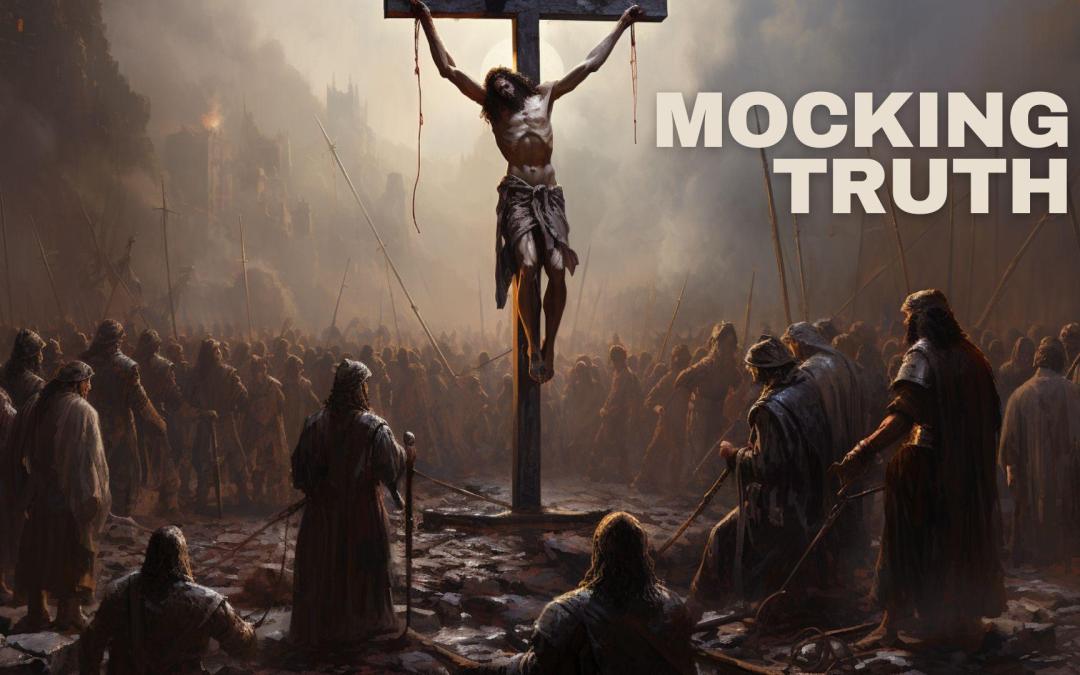
“Truth hurts”. We often think of that statement in the sense of speaking truth to someone for their own good, to confront them with something wrong. Yet, in this passage of Scripture, we see truth spoken to the Truth, Jesus, in the form of hurtful mockery.
The people stood watching, and the rulers even sneered at him. They said, “He saved others; let him save himself if he is God’s Messiah, the Chosen One.” (Luke 23:35)
They mocked Jesus with His very deeds, His titles, His true character. The enemy mocks us with truth but twists it to “prove” truth in a way or time that is not God’s will.
Jesus did save others. He did not save Himself at the time because He was saving the world at that moment. By dying, Jesus was actually proving that He was God’s Messiah, the Chosen One. His first mission on earth was to die for our sins. However, at His second coming, He will rule and reign the world from Jerusalem. If He had shortcut His initial purpose, all of us would be eternally lost. But because He is the Messiah, He stayed on the cross to extend salvation to the world.
The soldiers also came up and mocked him. They offered him wine vinegar and said, “If you are the king of the Jews, save yourself.” (Luke 23:36-37)
Jesus is the King of the Jews. He is the King of kings. Yet, He knew that His rule would manifest later in history. By saving Himself, He would not have been crowned king.
That power is the same as the mighty strength he exerted when he raised Christ from the dead and seated him at his right hand in the heavenly realms, far above all rule and authority, power and dominion, and every name that is invoked, not only in the present age but also in the one to come. And God placed all things under his feet and appointed him to be head over everything for the church, which is his body, the fullness of him who fills everything in every way. (Ephesians 1:19b-23)
It was because of His death and resurrection that God put Jesus above all. Everything is under His feet because He was willing to die for our sins. The people mocked Him as a king and told him to save Himself, but it was His death that heralded His divine coronation.
One of the criminals who hung there hurled insults at him: “Aren’t you the Messiah? Save yourself and us!” (Luke 23:39)
The criminals wanted to be saved from their crossed and mocked Jesus with the truth of His Messiahship. The truth is that Jesus was saving them at that moment, if they so chose to receive it. The salvation was not a temporal escape from a cross but eternal salvation.
Often the enemy attacks us with truth. However, the enemy desires us to usurp God’s timing to have the truth manifest now. Jesus is Messiah, King, the Chosen One and much more. But if He had forced the truth instead of trusting God’s timetable, His purpose of saving the world would be thwarted. Instead, He chose to endure the pain, endure the mockery, suffer unto death so that we might be saved. In our own lives, we must trust God’s timetable so that more lives can be transformed to the glory of our Risen King!

by Shannon Tillman | Jan 22, 2024 | Thoughts
A messy journal entry is straight from my prayer journal. Sometimes, I write things down that are easier to transcribe (or fix some of the grammar and thoughts) then try to “tidy up” and make into a decent blog post. On this post I did add an additional thought to the end.
Thoughts on Deuteronomy 2:4-5,9
Give the people these orders: ‘You are about to pass through the territory of your relatives the descendants of Esau, who live in Seir. They will be afraid of you, but be very careful. Do not provoke them to war, for I will not give you any of their land, not even enough to put your foot on. I have given Esau the hill country of Seir as his own… Then the LORD said to me, “Do not harass the Moabites or provoke them to war, for I will not give you any part of their land. I have given Ar to the descendants of Lot as a possession.” (Deuteronomy 2:4-5,9)
God gave the land. He delegated the boundaries. The Lord even gave property to the enemies of Israel! He kept His Word to Esau and to Lot despite their unfaithfulness. Our Lord is faithful to His Word. Did knowing this encourage Israel to believe that what God did for others He would do even more for them?
Horites used to live in Seir, but the descendants of Esau drove them out. They destroyed the Horites from before them and settled in their place, just as Israel did in the land the LORD gave them as their possession. (Deuteronomy 2:12)
Esau fought for the land. They acquired the land because the Lord promised the land. If God fulfilled His word to Esau, then the people could trust the Lord for acquiring the land for Jacob (Israel).
Trust God. He is faithful to His Word. What He has promised, He will fulfill. Be encouraged by His fulfillment of His word to others. Do not compare or be jealous. Instead, let it increase your faith for what He will do for you.

by Shannon Tillman | Jan 15, 2024 | Bible Study
My idea of a workout is sitting on the beach. I would rather perspire lounging by a beautiful body of water than sweating during aerobics or weight training. I want to be healthy without any effort on my part. Yet, we all know that this is not how it works (sadly).
The same is true in our spiritual lives. It is the difficulties, sovereignly orchestrated by God for our benefit, that foster spiritual growth. The nation of Israel experienced this truth in the wilderness on their journey toward the Promised Land. They were on their way to the fulfillment of their hopes and dreams. However, a hostile king blocked them:
But Sihon king of Heshbon refused to let us pass through. For the LORD your God had made his spirit stubborn and his heart obstinate in order to give him into your hands, as he has now done. The LORD said to me, “See, I have begun to deliver Sihon and his country over to you. Now begin to conquer and possess his land.” (Deuteronomy 2:30-31)
A closed “road” may signal a spiritual fight to gain new territory. We want the Lord to make the path easy but He allows the fight. In fact, God divinely orchestrated the fight to benefit the Israelites. They wanted to pass “safely through” but God wanted them to take the enemy’s ground by His power.
The word Sihon in Hebrew means “warrior”. The word “Heshbon” in Hebrew means “stronghold”. The enemy we fight is a warrior who resides in a stronghold. This is not an easy fight! We must pull down the strongholds that the enemy has set up. We are called to fight instead of allowing the enemy to settle in our territory.
The weapons we fight with are not the weapons of the world. On the contrary, they have divine power to demolish strongholds. We demolish arguments and every pretension that sets itself up against the knowledge of God, and we take captive every thought to make it obedient to Christ. And we will be ready to punish every act of disobedience, once your obedience is complete. (2 Corinthians 10: 4-6)
We must not back down. A stronghold is any lie that is against the truth of God. Unless we dislodge the enemy with truth, he will stay settled in our lives. We must go into combat against the lies to dislodge the enemy. This is war!
The enemy told Israel “you can’t pass through.” But God told the Israelites “this is your land, go get it.” The enemy was telling a lie as if he was already victorious and the land was his. God was showing Israel that He alone is in charge.
Often our difficult circumstances will manifest the lies we believe about ourselves, others, our situations, and even God. These lies come up and are set up to block our victory. The Lord sovereignly allows this so we can experience even greater victory and freedom in our lives.